Introduction#
Commodities are one of the oldest traded asset classes in the world — but finding where to actually trade them isn't obvious. Unlike stocks, you can't just open any brokerage account and buy crude oil or wheat directly. Where you can trade commodities depends on your country, your experience level, and the method you choose.
This guide explains the three main routes for trading commodities, what each route costs, and which commodity trading platform is suited to each approach.
What Are Commodities?#
Commodities are standardised raw materials and primary goods — metals, energy, and agricultural products — that are bought and sold on regulated exchanges or through financial instruments that track their price.
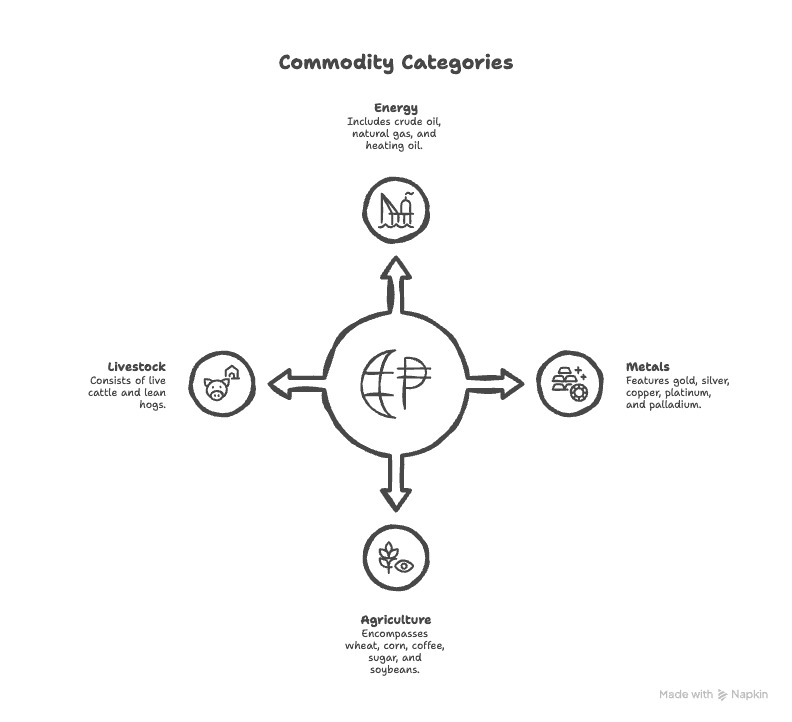
They fall into four main categories:
- Energy — crude oil (WTI and Brent), natural gas, heating oil
- Metals — gold, silver, copper, platinum, palladium
- Agriculture — wheat, corn, coffee, sugar, soybeans
- Livestock — live cattle, lean hogs
Commodities are unique because their prices are driven by physical supply and demand — weather, geopolitics, and production cycles — rather than corporate earnings or interest rate expectations.
Three Ways to Trade Commodities#
There are three distinct routes for gaining exposure to commodity prices. Each has different requirements, costs, and risk profiles.
- Futures contracts — The standard professional route. Futures are traded on regulated exchanges: the CME (Chicago Mercantile Exchange), ICE (Intercontinental Exchange), NYMEX (New York Mercantile Exchange), and COMEX. You buy or sell a standardised contract for delivery of a commodity at a specified future date. In practice, most traders close positions before expiry rather than taking physical delivery. A futures account requires regulatory approval and a minimum deposit. Exchange fees apply on every trade. See our guide to Gold Futures Trading Platform and Crude Oil Trading Software for specific contracts.
- CFDs (Contracts for Difference) — A synthetic instrument that tracks the price of a commodity without requiring you to own or deliver it. CFDs are available through most retail brokers globally and offer high leverage with lower account minimums. Important: CFDs are not available to US residents and are banned in several jurisdictions. Always check your country's regulations before using a CFD broker.
- Commodity ETFs — The simplest route for beginners. Exchange-traded funds that track commodity prices are available through any stock brokerage account — no special approval required. ETFs offer lower leverage and lower risk than futures or CFDs. They are less efficient for short-term trading but well-suited for long-term commodity exposure.
How to Choose a Commodity Trading Platform#
The right commodity trading platform depends on which route you're taking and which markets you want to access. Here's what to look for:
- Regulation — In the US, futures brokers must be registered with the CFTC and be NFA members. CFD brokers are regulated by the FCA (UK), ASIC (Australia), or similar authorities. ETF brokers fall under standard securities regulation (FINRA, SEC).
- Available commodity markets — Not every broker offers access to all exchanges. Confirm the platform covers the specific commodities you want to trade (e.g., COMEX for gold, NYMEX for crude oil, CBOT for agricultural commodities).
- Margin requirements — Futures require substantial margin per contract. A single crude oil (CL) futures contract requires roughly $6,000 in day-trading margin. Micro contracts (MCL) reduce this significantly.
- Data feeds — Real-time commodity prices require a subscription to the relevant exchange data feed. Delayed data (10–15 minutes) is usually free but not suitable for active trading.
- Mobile access — For commodity traders who monitor markets during the day, a reliable mobile app with order entry is important.
For a broader overview of platform costs and what "free" actually includes, see Free Futures Trading Platform.
Common Mistakes When Trading Commodities#
- Not understanding contract sizes — One standard crude oil futures contract (CL) represents 1,000 barrels of oil. At $70/barrel, the notional value of one contract is $70,000. A $10 move per barrel means $10,000 profit or loss. Micro contracts exist precisely to reduce this exposure — micro crude (MCL) is 1/10th the size.
- Ignoring roll-over costs — Futures contracts expire. Monthly contracts (like crude oil) and quarterly contracts (like some equity index futures) must be "rolled" before expiry if you want to maintain exposure. Rolling involves closing the expiring contract and opening the next one — and this has a cost (the roll spread).
- Trading without a risk plan — Commodities can be highly volatile. The EIA weekly inventory report, OPEC announcements, and geopolitical events can move crude oil by $2–5 in seconds. Trade only with capital you can afford to lose, and always use stop-losses.
Key Takeaways#
- Futures exchanges (CME, ICE, NYMEX, COMEX) are the primary markets for commodity trading.
- CFDs offer flexible access to commodity prices but are banned for US residents.
- Commodity ETFs are the simplest entry point — no special account approval required.
- Futures contracts have specific margin requirements; micro contracts reduce the capital needed.
- Always check that your broker is regulated by the relevant authority in your jurisdiction.