Introduction#
In futures markets, going short is just as easy as going long — there's no borrowing, no locate fee, and no uptick rule. You simply sell a futures contract at the current price, and if the price falls, you buy it back for a profit.
This symmetry is one of the features that makes futures popular with professional traders and hedgers. Understanding how to short a futures contract — and when it's the appropriate tool — is a core part of trading any futures market effectively.
What Does It Mean to Short a Futures Contract?#
Shorting a futures contract means selling a contract you don't currently hold, with the obligation to buy it back at a later date. You profit if the price falls between your sale and your repurchase, and you lose if the price rises.
This works because futures are standardised agreements, not ownership of a physical asset. You're not borrowing anything from anyone. You're simply agreeing to sell at today's price and settling the difference when you close the position.
Compare this to shorting stocks, where you must borrow shares from another investor (often paying a borrow fee), sell them, and later buy them back to return to the lender. Stock short sellers face hard-to-borrow fees, forced buy-ins if shares become unavailable, and short squeeze dynamics. None of these apply to futures.
How Shorting Futures Works#
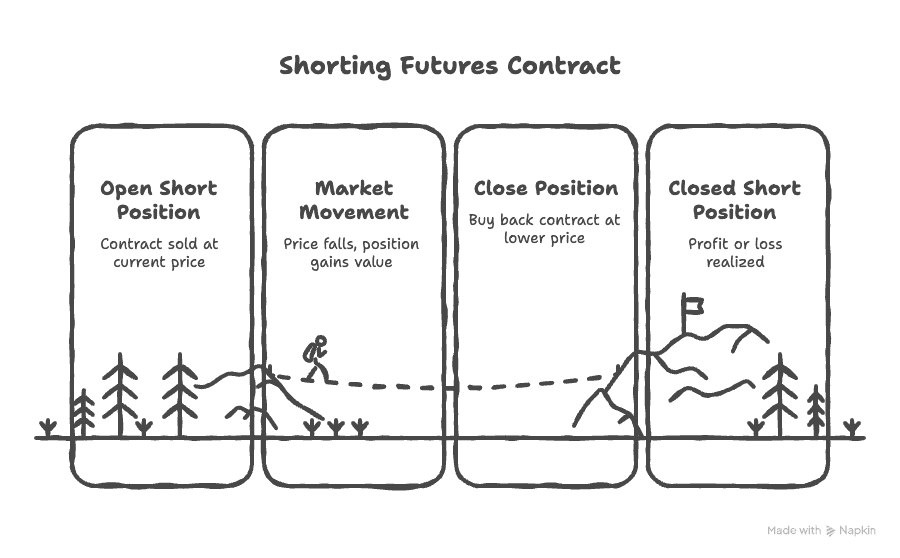
The mechanics of a short futures position are straightforward:
- You sell (go short) a futures contract at the current market price. Your broker requires margin — a performance deposit — to hold the position. This is identical to the margin required for a long position.
- The market moves. If the underlying asset's price falls, your position gains value. If it rises, your position loses value.
- You close the position by buying back the same futures contract (the same expiry month and product). The difference between your sell price and your buy price is your profit or loss.
- Settlement — if you hold to expiry, most financial futures (equity index, currency, interest rate) settle in cash. Physical commodity futures (crude oil, gold) require delivery if held to expiry — which is why active traders always close or roll positions before the last trading day.
The margin requirement is identical for long and short positions. Futures markets treat buying and selling as equivalent obligations, which is why going short requires no additional account approval or special permission.
When Traders Short Futures#
Shorting a futures contract serves several distinct purposes:
- Speculation — Betting that a price will fall. A trader who expects crude oil prices to drop ahead of a large inventory build might short CL (crude oil) futures to profit from the anticipated decline.
- Hedging — Locking in a future sale price. A gold mining company that expects to produce 10,000 ounces of gold in six months might short gold (GC) futures now to lock in today's price, protecting against a price decline before delivery.
- Pairs trading — Taking a long position in one futures contract and a short position in a related or correlated contract. For example, long E-mini S&P 500 (ES) and short E-mini Nasdaq (NQ), expressing a view that large-cap stocks will outperform tech.
- Portfolio protection — An equity investor holding a diversified stock portfolio might short S&P 500 futures to reduce overall market exposure during a period of uncertainty, without selling their underlying positions.
Risks of Shorting Futures#
Short futures positions carry risks that are qualitatively different from long positions:
Theoretically unlimited upside risk — When you buy a futures contract, the maximum you can lose is the full value of the contract (if the price goes to zero). When you sell a futures contract, prices can rise indefinitely — there is no ceiling. In practice, you manage this with stop-loss orders, but the theoretical risk is unlimited.
Margin calls — If the market moves against a short position, your account balance falls. If it falls below the maintenance margin threshold, your broker will issue a margin call requiring you to deposit additional funds or face automatic liquidation.
Overnight gap risk — Futures trade nearly 24 hours, but major news events can cause sharp price gaps. A geopolitical event overnight can move crude oil or gold significantly before you have a chance to adjust your short position.
Shorting futures carries the same margin requirements as going long, but the risk is theoretically unlimited because prices can rise without a ceiling. Always use a stop-loss when holding a short futures position.
Common Mistakes When Shorting Futures#
- Trading without a stop-loss — A 2% gap against a short position on a leveraged futures contract can wipe a small account. Short positions require pre-defined exits, not hopeful monitoring.
- Shorting into a strong trend — The futures market is a zero-sum game between well-capitalised participants. Trying to short a strongly trending market because "it's gone too far" is an expensive strategy. Price can remain elevated far longer than an undercapitalised short position can survive.
- Ignoring contract expiry — Rolling a short position from one expiry month to the next involves closing the current contract and opening a new one. The roll spread — the price difference between months — adds a cost to holding a short position through expiry. This matters especially in commodity markets where contango or backwardation affects the roll cost.
Key Takeaways#
- Shorting a futures contract is mechanically simpler than shorting stocks — no borrowing, no borrow fees, no forced buy-ins.
- Long and short positions have identical margin requirements in futures markets.
- Short futures are used for speculation, hedging, pairs trading, and portfolio protection.
- The risk of a short position is theoretically unlimited — always use a stop-loss.
- Watch contract expiry dates — rolling a short position has costs, especially in contango markets.