Introduction#
Paper trading is the only way to test a futures strategy without risking real money — but most traders do it wrong. They trade unrealistic position sizes, skip the journalling, and treat a demo win as evidence that they're ready to go live. Then they're surprised when real-money results are different.
Learning how to paper trade futures properly is a genuine skill. This guide walks through the setup process, how to run a meaningful practice session, and the honest limitations of simulated trading.
What Is Paper Trading?#
Paper trading — also called simulated trading or demo trading — lets you place futures orders using virtual capital in a real market environment. Prices are live and real; the money is not.
A futures paper trading account tracks the same price feeds as a live account. Your orders execute against real market prices at the time you place them. The key difference is that fills happen under idealised conditions — at the best available price, without slippage, and with immediate confirmation.
Most major futures platforms include a built-in paper trading mode. You typically switch between simulated and live mode within the same application, using the same interface, same charts, and same order types.
How to Set Up a Futures Paper Trading Account#
Setting up a futures demo account is straightforward on most platforms. Here's the general process:
- Choose a platform that includes a futures simulator. Most major futures platforms offer this — look for a "simulation," "demo," or "paper trading" mode in the platform settings or account menu.
- Download and install the platform (if desktop-based). Some platforms also offer paper trading through a browser or mobile app.
- Select "demo" or "simulated" mode during setup. This is usually a toggle or a separate login. Some brokers offer a standalone paper trading account without requiring a live account first.
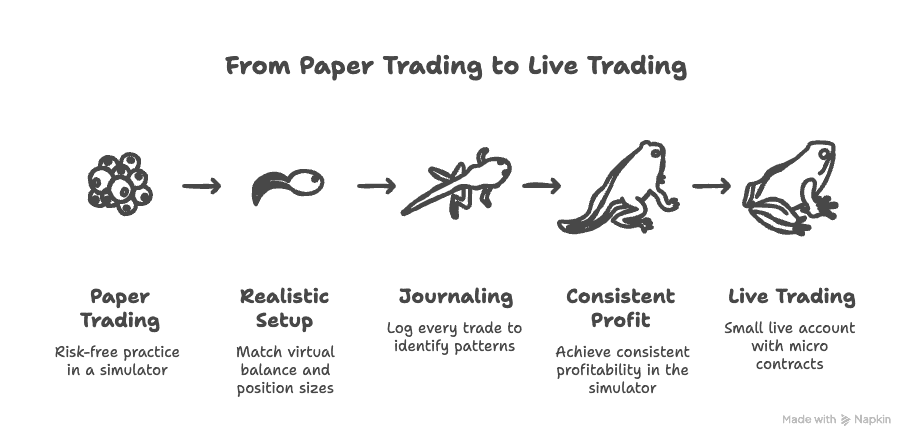
- Fund the virtual account with a realistic amount. Most platforms default to $50,000–$100,000 in virtual capital. This is unrealistic if you plan to trade a live account with $2,500. Manually adjust the starting balance to match what you'd actually deposit. This is the single most important step for meaningful practice.
- Start trading as if it were real money. Use the same position sizes, the same contract types, and the same stop-loss levels you'd use with real capital.
How to Get the Most From Paper Trading#
The value of a futures paper trading session is entirely determined by how seriously you treat it. Here's how to make it count:
- Use realistic position sizes — If you'd trade one MES contract with $2,000 in a live account, trade one MES contract in the simulator. Don't trade ten contracts because the money isn't real. The goal is to build correct habits.
- Keep a trading journal — Record every trade: entry price, exit price, the reason for the trade, and the outcome. After 50–100 trades, patterns will emerge. This is where real learning happens.
- Paper trade for at least 2–4 weeks before going live — One week of paper trading is not enough to test how a strategy performs across different market conditions. Include both trending and choppy sessions in your evaluation.
- Focus on one or two contracts — Depth of knowledge in one market is more valuable than shallow familiarity with many. The MES (Micro E-mini S&P 500) and MNQ (Micro E-mini Nasdaq) are good starting contracts. For symbol details and contract specs, see Futures Contract Symbols.
Limitations of Paper Trading#
Paper trading is valuable preparation — but it is not a substitute for live trading experience. Be honest about its limits:
Fills are unrealistically fast. In a simulated account, your order fills at the exact price you see. In a live account, market orders can experience slippage — especially during volatile periods. Limit orders may not fill at all if the market moves quickly.
There is no emotional pressure. Real money changes how you think. Watching a position move $300 against you in a live account creates psychological pressure that paper trading simply cannot replicate. Discipline that feels easy in a simulator often breaks down with real stakes.
Virtual capital distorts risk management. If your demo account starts with $50,000 but you plan to live-trade with $3,000, your position sizing in the demo is meaningless. Always configure the paper account to match your planned live account size.
Key Takeaways#
- Paper trading is free and risk-free — there's no reason not to start here before going live.
- Set the virtual account balance to match your planned real deposit for meaningful practice.
- Use realistic position sizes — trading 10 contracts in the simulator when you'd trade 1 live defeats the purpose.
- Keep a journal and log every trade — patterns and mistakes become visible over time.
- Graduate to a small live account with micro contracts when your simulator results are consistently profitable over several weeks.