Opening a trading account in the UAE is a straightforward process for residents and expatriates alike — but understanding what to prepare before you start, and what decisions you need to make upfront, makes the difference between a smooth experience and unnecessary delays.
This guide covers everything you need to open a trading account in the UAE: the types of accounts available, the documents required for identity verification, the step-by-step process, how to fund your account, and the most common mistakes first-time traders make at this stage.
Types of Trading Accounts in the UAE#
Before beginning the registration process, decide which account type suits your goals. Most brokers serving UAE traders offer several options:
Standard (spread-based) accounts — The broker earns through the bid/ask spread. No per-trade commission is charged. This is typically the entry-level account type, often with a low or zero minimum deposit. Well-suited to beginners who want to start with smaller capital.
ECN or Raw Spread accounts — Near-raw interbank spreads plus a fixed commission per lot. The total cost is usually lower for traders who trade frequently or in larger sizes. These accounts often require a higher minimum deposit than standard accounts.
Swap-free (Islamic) accounts — Available at many brokers serving the UAE and broader MENA market. Overnight interest (swap) charges are removed in compliance with Islamic finance principles and replaced with an alternative fee structure. Review the broker's specific terms before selecting this account type, as structures vary.
Managed accounts — A portion of your capital is managed by a professional trader or algorithmic system. These carry additional risks and require careful due diligence on the manager's credentials and strategy. Regulatory requirements around managed accounts are strict — ensure any manager is properly authorised.
Demo accounts — A simulated trading environment using virtual funds. Available at virtually all retail brokers. This is where you should begin, regardless of prior experience with other platforms or brokers.
Documents Required for UAE Account Opening#
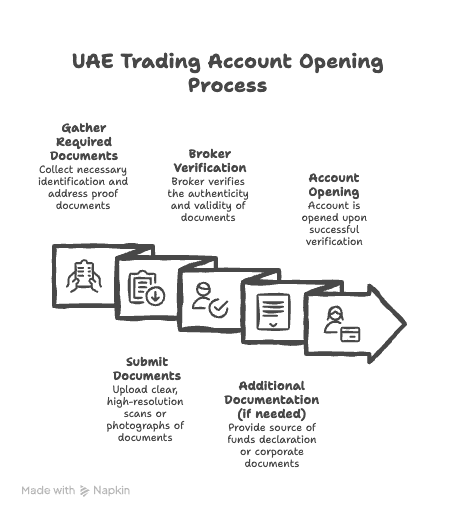
Forex and CFD brokers are required to verify the identity and address of all clients as part of KYC (Know Your Customer) and AML (Anti-Money Laundering) obligations. The standard documentation required to open a trading account in the UAE is:
Proof of identity — A valid government-issued photo identification document. Acceptable options typically include:
- UAE National ID card (for UAE nationals)
- Passport (accepted universally; most common for expatriates)
- Emirates ID card (for UAE residents)
Proof of address — A document confirming your current UAE residential address, issued within the past three to six months. Acceptable options typically include:
- A utility bill (electricity, water, gas, or internet)
- A bank statement from a UAE bank showing your name and address
- An official government letter or tenancy contract
Additional documents (sometimes requested) — Some brokers may ask for a source of funds declaration for larger initial deposits, or additional documentation for corporate accounts. First-time retail accounts opening standard positions are unlikely to encounter this.
Submitting clear, high-resolution scans or photographs of your documents speeds up the verification process significantly. Poor image quality is one of the most common causes of verification delays.
The Account Opening Process Explained#
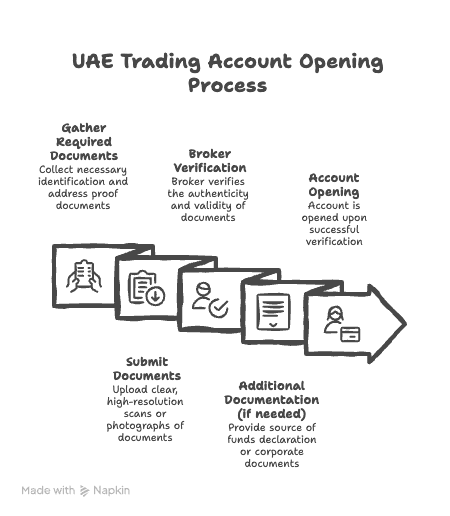
Most brokers serving UAE traders offer a fully online account opening process. The typical stages are:
1. Choose your broker
Select a broker that is regulated to an appropriate standard, offers the platform and account type you need, and whose cost structure suits your trading style. Refer to our guide on evaluating forex brokers in the UAE for the key criteria.
2. Register online
Complete the broker's online registration form with your personal details: full legal name, date of birth, email address, phone number, and country of residence. You will also be asked about your trading experience, financial situation, and risk awareness — answer these accurately, as brokers use this information to assess suitability.
3. Submit identity verification documents (KYC)
Upload your proof of identity and proof of address through the broker's secure document submission portal. Some brokers also offer video verification as an alternative to document upload.
4. Account approval
The broker's compliance team reviews your application. This typically takes between a few hours and two business days. You will receive a confirmation email when your account is approved, along with login credentials for the trading platform.
5. Fund your account
Once approved, deposit funds using your preferred payment method (see the section below on funding options). Most brokers require a minimum deposit to activate a live account.
6. Download and set up your platform
Install the trading platform specified by your broker (MT4, MT5, cTrader, or a proprietary app). Log in with your account credentials, configure your workspace, and you are ready to trade.
Why Start With a Demo Account#
A demo account lets you trade in real market conditions using virtual funds — no real capital at risk. Before placing your first live trade, use the demo environment to:
- Learn the platform interface — Understand order placement, position management, and chart navigation before real money is involved.
- Test your strategy — Validate whether your approach works under realistic conditions before committing capital.
- Evaluate the broker's execution — Assess fill speeds, price feed quality, and platform stability. If something seems wrong in demo, treat it as a signal.
- Understand the cost structure — Watch how spreads move during different sessions and around news events.
Most brokers offer demo accounts with no expiry and no pressure to convert to a live account. Take as long as you need.
Key insight: Transitioning from demo to live trading involves real psychological differences — the presence of real capital at stake changes decision-making. Start live trading with position sizes smaller than what you used in demo until you are comfortable with the emotional dimension of risk.
Funding Your Account: Methods Available in the UAE#
Once your account is approved, you will need to deposit funds before placing live trades. Common funding methods available to UAE traders include:
Bank transfer (SWIFT or local) — Available at most brokers. Processing times range from one to five business days for international transfers. Some brokers offer UAE local bank transfer options with faster processing. Usually the lowest cost method for larger deposits.
Credit and debit cards — Visa and Mastercard are accepted by most brokers. Processing is typically instant or within a few hours. Some UAE banks block transactions to certain financial services merchants — contact your bank if a card transaction is declined.
E-wallets — Skrill and Neteller are the most commonly accepted. Processing is fast, often instant. Not all brokers accept e-wallets, and some charge additional fees for e-wallet deposits or withdrawals.
Cryptocurrency — A small number of brokers accept cryptocurrency deposits. Processing is fast but exchange rate volatility between deposit and conversion to account currency adds a variable element to the effective deposit amount.
The same method used to deposit is typically required for withdrawals, to comply with AML regulations. Familiarise yourself with the withdrawal process and associated timescales before depositing, not after.
Common Mistakes to Avoid#
First-time traders in the UAE frequently encounter the same avoidable problems during and after account opening:
Skipping the demo account — Moving directly to a live account without testing the platform and practising order management leads to avoidable errors under real market conditions.
Choosing a broker based solely on bonus offers — Deposit bonuses and trading credits often come with restrictive terms that make withdrawal difficult. Focus on cost structure, regulation, and platform quality instead.
Submitting unclear documents — Low-resolution photographs or partially cropped ID documents delay verification. Use your phone's document scanning mode or a flatbed scanner for clear, full-size images.
Depositing more than you can afford to lose — Retail trading involves substantial risk of loss, particularly when leverage is involved. Start with an amount that you are prepared to lose entirely without affecting your financial situation.
Ignoring the cost structure — Spreads, commissions, and overnight swap rates add up. Understand your total per-trade cost before trading at size.
Quick Summary#
- Opening a trading account in the UAE requires proof of identity (passport, Emirates ID, or national ID) and proof of UAE address issued within the past three to six months.
- Account types include standard spread-based, ECN/raw spread, and Islamic swap-free options. Choose based on your trading style and capital level.
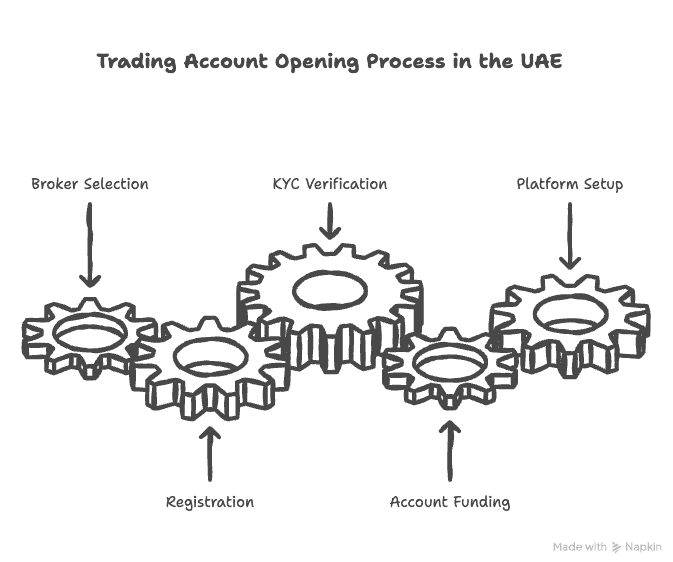
- The typical process: register online, submit KYC documents, await approval (hours to two days), fund the account, set up the platform.
- Always start with a demo account to learn the platform and evaluate the broker before risking real capital.
- Funding options include bank transfer, credit/debit card, and e-wallets. Use the same method for withdrawals.
- Avoid brokers selected primarily on bonus offers — evaluate regulation, costs, and platform quality first.
Related Concepts#
- Best Forex Brokers in UAE — How to evaluate forex brokers available to UAE traders
- Best Trading Platform in UAE — Platform types, features, and how to choose the right one
- Regulated Forex Brokers in UAE — Understanding the UAE regulatory landscape and how to verify a broker