Introduction#
An individual brokerage account is the most common way to start investing. Unlike retirement accounts, it has no contribution limits and no withdrawal restrictions — you can buy and sell stocks, bonds, ETFs, and other securities at any time.
Opening one takes about 10 minutes at most brokers. The harder question is choosing the right account type and understanding what protections come with it. This guide walks through the options.
Types of Brokerage Accounts#
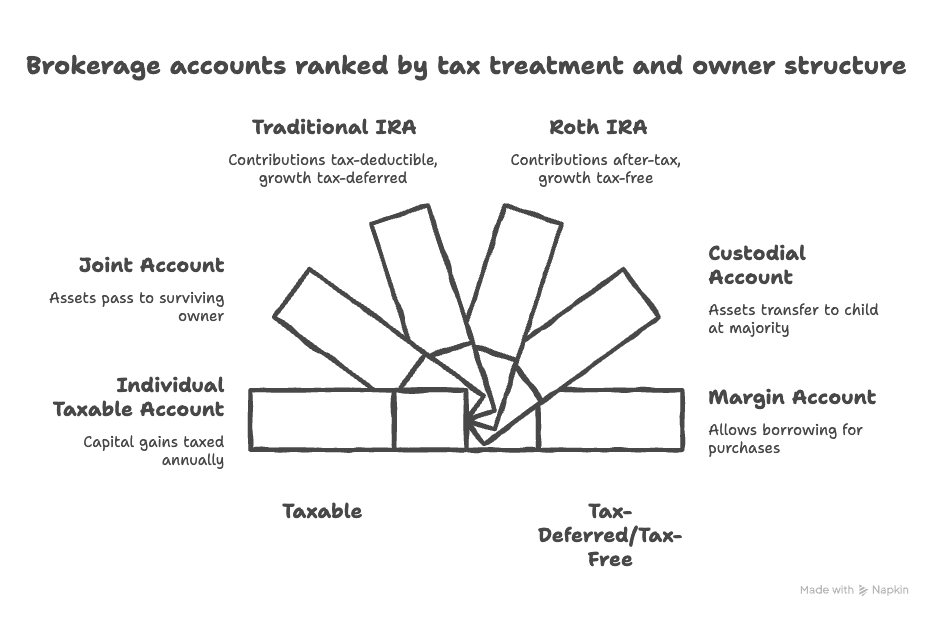
Individual taxable account. The standard single-owner account. No contribution limits, no age restrictions on withdrawals. Capital gains are taxed in the year they occur. This is the default choice for non-retirement investing.
Joint account. Two or more owners. Common options include joint tenants with right of survivorship (JTWROS), where assets pass directly to the surviving owner, and tenants in common, where each owner's share goes to their estate.
Traditional IRA. Contributions may be tax-deductible (subject to income limits). Growth is tax-deferred. Withdrawals are taxed as income. Contribution limits for 2026: $7,500 under age 50, $8,600 for age 50 and over.
Roth IRA. Contributions are made with after-tax dollars. Growth and qualified withdrawals are tax-free. Income limits apply — for 2026, full contributions are available for single filers under $153,000 and joint filers under $242,000. Same contribution limits as Traditional IRA.
Custodial accounts (UGMA/UTMA). Accounts for minors managed by a parent or guardian. UGMA covers cash and financial investments; UTMA also includes physical property. Assets transfer to the child at the age of majority (usually 18 for UGMA, 18–25 for UTMA depending on state). For 2026, the first $1,350 of earnings is tax-exempt, the next $1,350 is taxed at the child's rate, and amounts above that are taxed at the parent's rate.
Cash account vs margin account. A cash account requires you to pay the full cost of every purchase. A margin account lets you borrow up to 50% of a purchase price (under Regulation T), with a minimum $2,000 deposit required by FINRA. Most brokers require 30–40% maintenance margin, above FINRA's 25% minimum.
What You Need to Open an Account#
Every broker requires the same baseline information:
- Government-issued photo ID — driver's licence or passport
- Social Security Number (US) or national ID (non-US)
- Proof of address — utility bill or bank statement
- Personal details — name, date of birth, employment status, income range
- Suitability questionnaire — investment experience, risk tolerance, and objectives. This determines what products you can trade (particularly options and margin)
Minimum deposits at major brokers#
All four of the largest US brokers — Schwab, Fidelity, Interactive Brokers, and Robinhood — require $0 to open a standard brokerage account. Margin accounts require $2,000 (FINRA rule).
How to Transfer an Existing Account#
If you already have a brokerage account and want to move it, the ACAT (Automated Customer Account Transfer) system handles in-kind transfers of securities between brokers without selling.
- Timeline: completed within 6 business days (FINRA rule)
- Outgoing transfer fee: typically $50–$100 at the sending broker
- Incoming transfer fee: usually $0 at the receiving broker
- Fee reimbursement: some brokers reimburse outgoing fees — SoFi, for example, covers up to $75 for transfers of $5,000 or more
The advantage of ACAT over selling and rebuying is that you avoid triggering capital gains taxes.
Account Protection#
SIPC (Securities Investor Protection Corporation). If a SIPC-member firm fails, SIPC covers up to $500,000 per account (including a $250,000 cash sub-limit). This protects stocks, bonds, mutual funds, and money market funds. It does not cover commodity futures, forex, or unregistered investments. Multiple accounts held in "separate capacity" — such as an IRA and a taxable account — each receive full coverage.
FDIC for brokerage accounts. FDIC does not directly insure brokerage accounts. It applies only to uninvested cash held in bank sweep programs. Coverage depends on how many partner banks the broker uses — Fidelity sweeps across multiple banks for up to $4 million in FDIC coverage; Robinhood offers up to $2.5 million individual or $5 million joint. The standard FDIC limit remains $250,000 per depositor, per bank.
Common Mistakes#
- Opening a margin account without understanding margin calls. If your investments drop, the broker can issue a margin call requiring you to deposit more funds or liquidate positions — sometimes with little notice.
- Choosing an account type based on tax savings alone. Roth and Traditional IRAs have withdrawal restrictions. If you may need the money before retirement, a taxable account gives you more flexibility despite the tax disadvantage.
- Overlooking the ACAT option. Selling everything, withdrawing cash, and redepositing at a new broker creates unnecessary tax events. An in-kind ACAT transfer avoids this.
Key Takeaways#
- An individual brokerage account is the most flexible account type — no contribution limits, no withdrawal restrictions
- All major US brokers now require $0 minimum to open a standard account
- Roth IRA contributions for 2026 are capped at $7,500 ($8,600 for age 50+) with income limits
- ACAT transfers move securities between brokers in 6 business days without selling
- SIPC covers up to $500,000 per account if your broker fails; FDIC only covers uninvested cash in sweep programs
- Choose the account type that matches your time horizon and tax situation — not just the one with the best tax break