Introduction#
Gold is one of the most traded commodity futures contracts in the world. For traders looking to access the gold market professionally — with leverage, nearly 24-hour trading, and exchange-level transparency — gold futures are the standard instrument. But choosing the right gold futures trading platform requires knowing which exchange gold trades on, what the contract specifications look like, and what platform features matter specifically for this market.
What Are Gold Futures?#
Gold futures are standardised contracts to buy or sell a specific quantity of gold at a predetermined price on a future delivery date. They trade on the COMEX division of the CME Group in New York.
There are two main gold futures contracts:
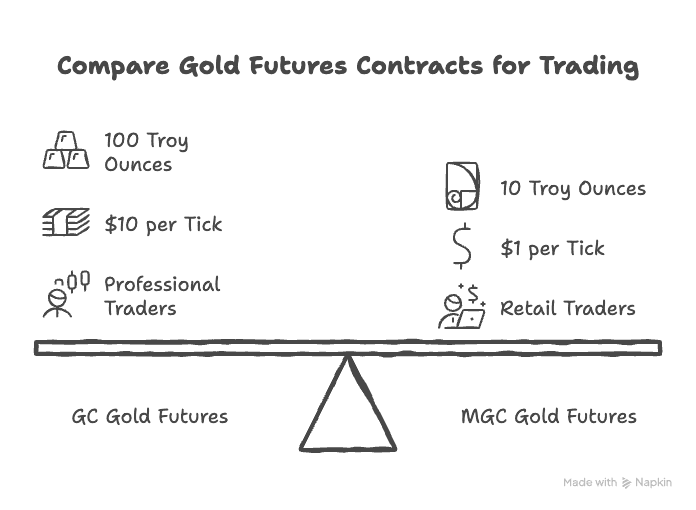
- GC (Full-size Gold Futures) — 100 troy ounces per contract. At $2,000/oz, one contract has a notional value of $200,000. Each tick (minimum price move of $0.10) is worth $10. This is the professional-grade contract and carries significant leverage.
- MGC (Micro Gold Futures) — 10 troy ounces per contract. Exactly 1/10th the size of GC. Each tick is worth $1. This is the accessible entry point for retail traders learning the gold market.
Both contracts track the same underlying price and are traded on the same COMEX exchange. The only difference is size — and that size difference matters enormously for position sizing and risk management.
What to Look for in a Gold Futures Platform#
Not every futures platform is equally equipped for gold futures trading. Here are the key criteria:
- COMEX data feed — You need real-time COMEX market data to trade gold futures actively. Check whether the platform includes COMEX data in its standard package or charges an additional subscription fee. COMEX real-time data typically costs $5–15/month.
- Margin rates for GC and MGC — Day-trading margin for the full GC contract is typically $3,000–$8,000 per contract (rates vary by broker and market conditions). Micro gold (MGC) requires roughly $300–$800 in day-trading margin. Confirm your broker's current rates before opening a position.
- Charting with volume profile — Gold responds strongly to key price levels and volume clusters. A platform with volume profile charting (also called market profile) helps identify where significant trading activity has occurred at specific price levels — a useful tool for gold traders.
- Mobile access — Gold reacts to news events during all hours: Fed announcements, inflation data, geopolitical developments, and currency moves. A reliable mobile app with order entry matters if you monitor positions outside regular US hours.
- Commission per contract — For gold specifically, the exchange fee on COMEX is approximately $0.58–$1.50 per contract per side. Add your broker's commission on top. For micro gold (MGC), total all-in costs are much lower per trade.
Full-Size vs Micro Gold Contracts#
The choice between GC and MGC comes down to account size and experience:
| Feature | GC (Full Gold) | MGC (Micro Gold) |
|---------|---------------|-----------------|
| Contract size | 100 troy oz | 10 troy oz |
| Tick size | $0.10/oz | $0.10/oz |
| Tick value | $10.00 | $1.00 |
| Typical day margin | $3,000–$8,000 | $300–$800 |
| Best for | Experienced traders | Beginners, small accounts |
| Notional value (at $2,000/oz) | $200,000 | $20,000 |
The leverage in a full GC contract is significant. A $20/oz move in gold (which can happen in minutes during a major news event) represents a $2,000 gain or loss on one GC contract. The same move on MGC is $200.
For beginners, starting with micro gold (MGC) is the sensible approach. The risk is 1/10th, but the learning experience is identical. For the full contract spec reference, see Futures Contract Symbols.
Common Mistakes Trading Gold Futures#
- Trading full-size GC with a small account — One tick on GC is $10; one tick on MGC is $1. A new gold futures trader using GC when they should be using MGC is taking on 10x the risk for the same market exposure. Start with micro gold until your account and strategy can support full-size contracts.
- Ignoring COMEX data feed costs — Gold futures traders need COMEX real-time data, which is a separate subscription from CME equity data. If you're trading both gold and S&P 500 futures, check whether your platform bundles COMEX into its data package or bills it separately.
- Not watching the US dollar — Gold and the US dollar index (DX) are historically inversely correlated. When the dollar strengthens, gold often falls; when the dollar weakens, gold often rises. Monitoring the DX alongside your gold chart provides important context for price direction.
Key Takeaways#
- Gold futures (GC) trade on COMEX in 100-troy-ounce contracts; micro gold (MGC) is 1/10th the size.
- Micro gold (MGC) is the beginner-friendly entry point — identical market exposure at 1/10th the risk.
- COMEX real-time data is a separate subscription — factor this into your platform cost calculation.
- Gold futures trade nearly 24 hours and react strongly to currency moves, inflation data, and geopolitical news.
- Always monitor the US dollar alongside gold — their inverse relationship is one of the most consistent in commodity markets.