Introduction#
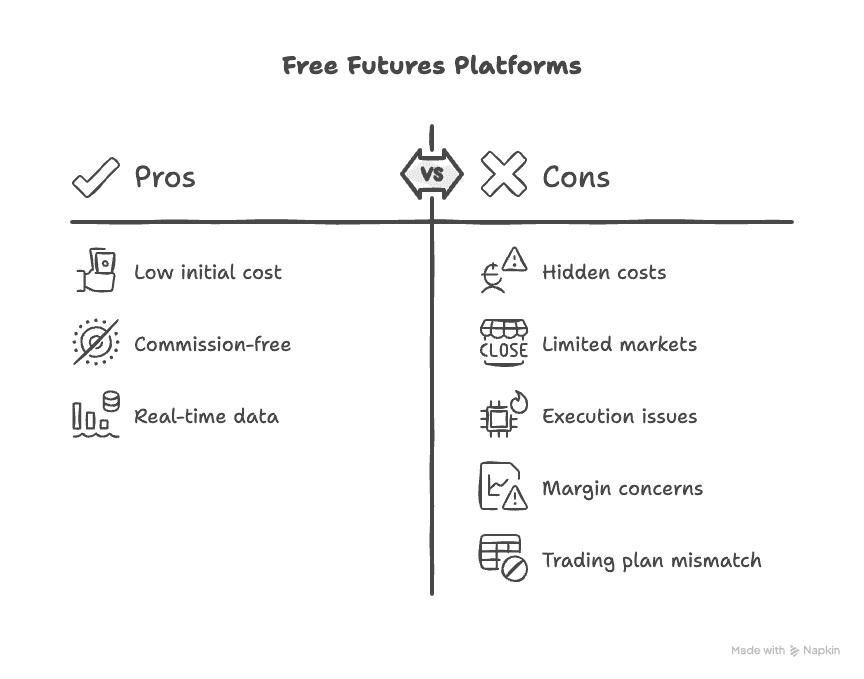
Most platforms that market themselves as a free futures trading platform still charge you — just not where you expect. Data fees, inactivity charges, and exchange-mandated commissions can add up to $50 or more per month before you place a single trade.
This guide breaks down exactly what "free" means in the context of futures trading, what the major cost categories are, and how to evaluate any platform against those criteria. By the end, you'll know which costs are genuinely avoidable and which ones follow you to every platform you use.
What Does "Free" Mean in Futures Trading?#
"Free" in futures trading almost always refers to one specific thing: no monthly platform subscription fee. It rarely means zero cost overall.
There are three distinct types of "free" you'll encounter when comparing platforms:
- Commission-free — the broker charges no fee per trade. Rare in regulated futures markets; most US brokers charge $0.25–$2.50 per contract per side.
- No platform fee — the software itself is free to use, but commissions and data fees still apply. This is the most common meaning.
- Free demo or paper trading — a simulated account with no real money at risk. This is genuinely free.
One cost that is never waived is the exchange fee. The CME Group (Chicago Mercantile Exchange) and ICE charge a fee on every futures contract traded, regardless of your broker. These fees are embedded in every trade and passed through to the trader. A typical CME exchange fee is $0.50–$1.50 per contract per side — on top of any broker commission.
Understanding this distinction protects you from choosing a platform based on headline claims that don't reflect your real cost of trading.
What Free Platforms Typically Include#
Most no-subscription futures platforms come with a solid base package. Here's what you can typically expect:
- Basic charting — candlestick, bar, and line charts with standard indicators (moving averages, RSI, MACD)
- Order entry — market, limit, and stop orders across all available futures markets
- Market data (delayed) — 10–15 minute delayed quotes are usually free; real-time data requires a subscription
- Paper trading mode — simulated trading with virtual capital, usually included
- Account management tools — margin tracker, P&L summary, order history
What you typically still pay for, even on a "free" platform:
- Real-time market data — CME real-time data costs $10–25/month per exchange (CME, CBOT, NYMEX, COMEX are sold separately)
- Advanced order types — bracket orders, trailing stops, and OCO (one-cancels-other) are sometimes gated behind paid tiers
- DOM (Depth of Market) trading — a full order book ladder is often a premium add-on
- Margin interest — on leveraged overnight positions, most brokers charge interest on margin used
The platform fee is just one line item. Your true monthly cost is: platform fee + data subscriptions + commissions + exchange fees + margin interest.
How to Evaluate a Free Futures Platform#
Use these five criteria to compare any platform before committing real capital:
- Commission structure — What is the all-in cost per contract, per side? This includes the broker's commission plus any platform surcharge. A broker advertising "free" commissions may embed the cost in a wider bid-ask spread.
- Data fees — Does the platform include real-time data for the exchanges you trade? If not, what does it cost to add? A platform with $0 subscription but $30/month in data fees may be more expensive than a $25/month all-in platform.
- Margin requirements — What is the day-trading margin per contract? Lower margin lets you trade with less capital, but also increases leverage. Compare intraday vs overnight margin rates.
- Available markets — Does the platform access the contracts you want to trade? CME, CBOT, NYMEX, COMEX, and ICE are the major US futures exchanges. Not every platform connects to all of them.
- Execution speed and reliability — A free platform is worthless if it crashes during a volatile session or has order routing delays. Check for independent reviews during high-volatility periods (e.g., NFP release days, FOMC announcements).
Weave in your actual trading plan when applying these criteria. A commission-free futures model matters more if you're placing 20+ trades per day. A scalper cares about execution latency above all else.
Paper Trading vs Live Trading on Free Platforms#
Paper trading (simulated trading with virtual money) is the only genuinely free way to engage with futures markets. Most major platforms offer a paper trading mode that mirrors live market conditions using real price data — at no cost.
The practical difference matters:
- Paper trading fills are executed at the best available price instantly. In a live account, your order competes with millions of others and may experience slippage — especially in fast-moving markets.
- A paper account typically starts you with $50,000–$100,000 in virtual capital. This bears no relationship to how you'd actually trade with $2,000 in a real account.
- There is no emotional pressure in paper trading. The psychological experience of live trading with real money is fundamentally different.
Use paper trading to learn the platform mechanics and test strategies. Don't use it as proof that a strategy will work live.
When you're ready to move to a live account, the minimum deposit and margin requirements come into play immediately. For a detailed look at what you actually need, see our guide to Futures Trading Minimum Account Size.
For a step-by-step walkthrough of setting up a futures simulator, see How to Paper Trade Futures.
Common Mistakes When Choosing a Free Platform#
- Ignoring data fees — Real-time CME data alone can cost $10–25/month per exchange. If you trade equity index futures (ES, NQ), energy futures (CL), and gold (GC), you may need three separate data subscriptions. Always calculate the all-in monthly cost.
- Confusing demo with live — A demo account with instant fills and zero emotional stakes is not representative of live trading. Use it to learn mechanics, not to validate a strategy.
- Overlooking margin requirements — A "free" platform still requires real capital. The broker's account minimum and the exchange's margin requirement are two different numbers, and both apply. Trying to trade with exactly the minimum leaves no buffer for adverse moves.
- Skipping regulation checks — Free should not mean unregulated. In the US, futures brokers must be registered with the CFTC and be members of the NFA. Always verify a broker's registration before depositing funds.
Key Takeaways#
- "Free" in futures trading almost always means no platform fee — not zero total cost.
- Exchange fees (CME, ICE) apply to every live trade and cannot be waived by any broker.
- Real-time data subscriptions are a common hidden cost — budget $10–30/month per exchange.
- Paper trading is the only truly free way to practice — but it doesn't replicate the psychology of live trading.
- Evaluate platforms on: commissions, data fees, margin rates, available markets, and execution reliability.