Introduction#
Day trading platforms are not created equal — and choosing the wrong one can cost you money before you place your first trade. Speed, reliability, and transparent pricing are non-negotiable, yet most platform marketing leads with features that look impressive but don't matter when the market moves fast.
This guide cuts through the noise. You'll learn what actually separates a good day trading platform from a mediocre one, the key features to compare side-by-side, and the mistakes traders make when picking their tools.
What Makes a Platform Good for Day Trading?#
Day trading is the practice of buying and selling financial instruments within the same trading session, aiming to profit from short-term price movements. Unlike swing trading or investing, day traders close all positions before the end of the trading day — which means execution speed and real-time data are critical, not optional.
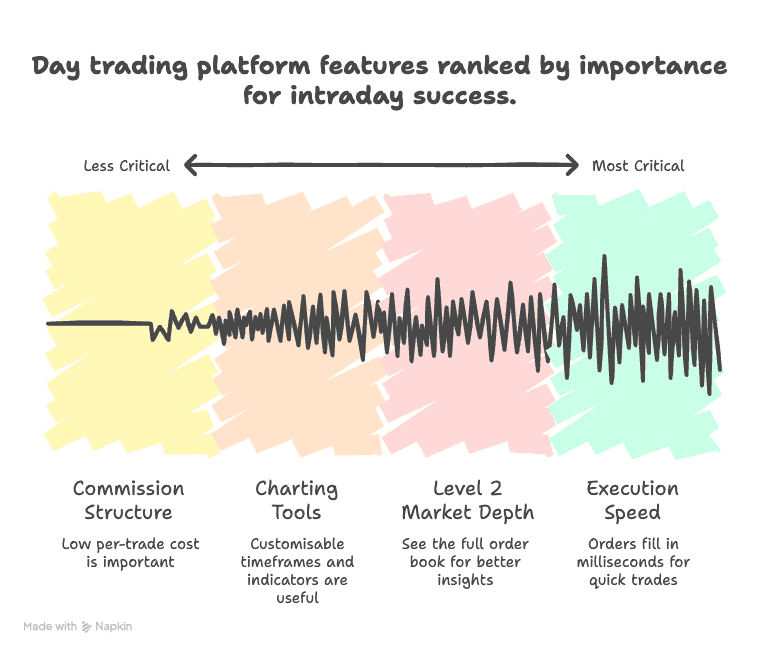
A platform built for day trading must deliver on four pillars:
- Execution speed — orders need to reach the exchange and fill in milliseconds, not seconds
- Level 2 market depth — see the full order book, not just the best bid and ask
- Charting tools — customisable timeframes, volume indicators, and drawing tools that don't lag
- Commission structure — low per-trade cost matters when you're placing 10–50 trades per day
The best trading platform for intraday work is the one that fails you least often, not the one with the most indicators on the toolbar. See our guide to Best Level 2 Trading Platform for a deep dive on order book data.
Key Features to Compare#
When evaluating day trading platforms side by side, these are the five factors that determine real-world performance:
- Order execution speed — Latency is the time between placing your order and receiving a fill confirmation. For scalpers and active day traders, even 100–500ms of additional latency can mean the difference between a profitable fill and a missed trade. Look for direct market access (DMA) routing, not order internalisation.
- Level 2 / market depth — Level 2 data shows every bid and ask price in the order book, along with the size behind each price level. This is critical for reading order flow, identifying large institutional orders, and confirming whether a price move has real volume behind it. Level 1 data (best bid/ask only) is not sufficient for serious day trading.
- Charting and indicators — Customisable timeframe options (1-minute, tick-based, range bars), volume profile, and a clean interface matter more than having 300 indicators. Check whether the charting refreshes in real time or on a delay.
- Commission and fee structure — Per-contract fees on futures, per-share fees on stocks, or per-lot fees on forex compound quickly when you're trading frequently. A $0.50 difference per contract doesn't sound like much until you've done 100 round trips in a week.
- Hot keys and order presets — One-click trading from a DOM (Depth of Market) ladder is standard for serious day traders. If you have to click through three menus to place a market order, you're not using a day trading platform — you're using an investing platform with a chart attached.
The best platform for intraday trading will also support a scalp trading platform workflow — ultra-short holds measured in seconds. See our guide to Scalp Trading Platform for the specific requirements.
Day Trading Futures vs Stocks vs Forex#
The platform you need also depends on what you're trading. Here's a quick comparison:
| Feature | Futures | Stocks | Forex |
|---------|---------|--------|-------|
| Minimum capital (day trading) | ~$500 (micro) | $25,000 (PDT rule) | ~$500 (varies) |
| Trading hours | Nearly 24 hours | 9:30am–4pm ET | 24/5 |
| Typical all-in cost | $1.50–$5.00/contract | $0.005/share or flat | 0.5–2 pip spread |
| PDT rule applies? | No | Yes (US) | No |
| Centralized exchange | Yes | Yes | No |
Futures stand out for day traders because there is no Pattern Day Trader (PDT) rule — the US regulation that requires $25,000 minimum equity to make more than three day trades per week in a margin stock account. Futures accounts have no such restriction.
For a detailed breakdown of futures day trading mechanics, see Day Trading Futures. For the broader picture on platform cost, see our Free Futures Trading Platform guide.
Mistakes Day Traders Make When Picking a Platform#
- Prioritising features over reliability — A platform with impressive-looking analytics tools means nothing if it crashes during a volatile NFP release or earnings announcement. Every serious day trader has a story about a platform failure costing them money. Reliability should be the first filter, not an afterthought.
- Ignoring margin call policies — Platforms handle margin differently. Some give you a margin call warning and time to act. Others auto-liquidate positions immediately when your account falls below the minimum margin threshold. Know your platform's policy before it becomes relevant.
- Choosing based on demo performance — Demo accounts typically fill orders at the best available price with zero latency. Live accounts experience slippage, partial fills, and occasional order rejections during fast markets. A strategy that worked flawlessly in a paper account may underperform significantly when real money and real market conditions are involved.
Key Takeaways#
- Execution speed and Level 2 data are the non-negotiable pillars of a day trading platform.
- Low commissions matter more than a polished interface — especially for high-frequency intraday trading.
- Futures have no PDT rule, lower capital requirements than US stocks, and nearly 24-hour markets.
- Test reliability during volatile sessions, not just normal market hours.
- Compare real all-in costs: commissions + data fees + exchange fees, not just the headline number.