Introduction#
Futures are one of the most popular instruments for day traders — and for good reason. There's no Pattern Day Trader rule requiring a $25,000 minimum account, markets are open nearly 24 hours, and leverage is built into the contract structure. Day trading futures lets you access some of the most liquid markets in the world with far less capital than comparable stock trading.
But the advantages come with genuine complexity. Understanding how futures margins work, which contracts suit different account sizes, and what it actually costs to trade is essential before you put real money at risk.
What Are Futures?#
A futures contract is a standardised legal agreement to buy or sell a specific asset — an index, commodity, currency, or interest rate instrument — at a predetermined price on a set future date.
The key insight for day traders: you almost never hold a futures contract to its expiry date. Day trading futures means you open and close positions within the same trading session, capturing short-term price movements. The contract's delivery date is largely irrelevant — what matters is the price difference between your entry and exit.
Futures trade on regulated exchanges (CME, CBOT, NYMEX, COMEX, ICE) and are cleared through a central clearinghouse, which eliminates counterparty risk. Every participant trades the same contract under the same terms — there's no market maker adjusting the spread against you.
Why Day Traders Choose Futures#
Several structural features make futures an attractive vehicle for intraday trading:
- No Pattern Day Trader rule — US stock traders must maintain $25,000 in account equity to place more than three day trades per week. This restriction does not apply to futures. You can day trade futures with a $500 account if you choose the right contract.
- Lower day-trading margins — Brokers set intraday margin requirements separately from the exchange's standard overnight margin. Intraday margin on an E-mini S&P 500 (ES) contract can be as low as $500–$1,000 at some brokers, compared to the $13,000+ overnight requirement.
- Nearly 24-hour markets — Most major futures contracts trade from Sunday evening through Friday afternoon US time, with only a brief daily maintenance pause. This allows traders in any time zone to participate and lets you react to overnight news.
- Tax advantages (US) — Under Section 1256 of the US tax code, futures contracts are taxed as 60% long-term capital gains and 40% short-term, regardless of how long you held them. This is more favourable than the short-term capital gains rate that applies to stock day trading profits.
- Transparent, centralised pricing — Futures prices are set on a central exchange with a single orderbook. There are no dark pools, no payment for order flow, and no hidden market maker spreads.
Popular Futures Contracts for Day Trading#
Different contracts suit different account sizes and risk tolerances. Here's a quick reference for the most actively traded futures among day traders:
| Contract | Symbol | Exchange | Tick value | Typical day margin |
|----------|--------|----------|------------|-------------------|
| E-mini S&P 500 | ES | CME | $12.50 | $500–$1,500 |
| Micro E-mini S&P 500 | MES | CME | $1.25 | $50–$150 |
| E-mini Nasdaq 100 | NQ | CME | $5.00 | $1,000–$2,000 |
| Micro E-mini Nasdaq | MNQ | CME | $0.50 | $100–$200 |
| Crude Oil | CL | NYMEX | $10.00 | $3,000–$6,000 |
| Gold | GC | COMEX | $10.00 | $3,000–$8,000 |
| Micro Gold | MGC | COMEX | $1.00 | $300–$800 |
Day margin rates vary by broker and are subject to change. Always verify current rates directly with your broker.
For a full explanation of contract naming and how to read a futures symbol, see Futures Contract Symbols.
How Much Capital Do You Need?#
Understanding the difference between day-trading margin and overnight margin is critical before you start.
Day-trading margin is the reduced margin requirement that applies while you are actively trading within a session. Many brokers offer intraday margin as low as $500 per E-mini S&P 500 contract. This is a broker-level policy, not an exchange requirement.
Overnight margin is the exchange's standard margin requirement, which kicks in if you hold a position past the broker's designated cutoff time (typically 15–30 minutes before market close). Overnight margin for ES is typically $13,000–$15,000 per contract. Holding an ES position overnight unexpectedly can result in an immediate margin call if your account balance is below that threshold.
Practical starting capital for new futures day traders:
- Micro contracts (MES, MNQ, MGC) — $1,500–$3,000 is a reasonable starting range. This gives you 2–3x the day-trading margin for one contract, leaving a buffer against adverse moves.
- Full-size contracts (ES, NQ, CL) — $10,000–$15,000 is a more appropriate starting range to trade responsibly with full-size contracts.
For a full breakdown of broker minimums and margin by contract, see Futures Trading Minimum Account Size.
Common Mistakes in Day Trading Futures#
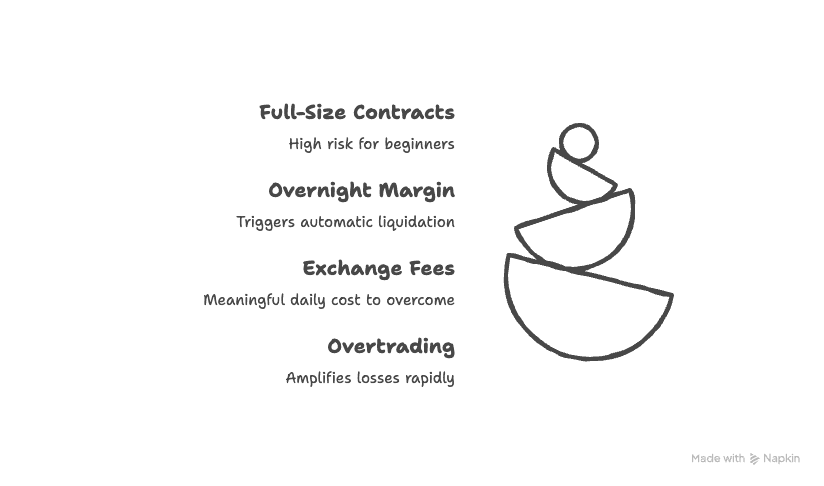
- Trading full-size contracts too soon — Micro contracts exist for a reason. One ES contract moves $12.50 per tick; one MES contract moves $1.25. A 10-tick adverse move on ES costs $125; the same move on MES costs $12.50. Start with micros until you are consistently profitable.
- Ignoring overnight margin — If you hold a position past the broker's intraday cutoff — even accidentally — your account is subject to the full overnight margin requirement. This can trigger an automatic liquidation if your account balance doesn't cover it.
- Underestimating exchange fees — CME exchange fees range from approximately $1.18 to $2.50 per contract per side, depending on the product. On 20 round trips per day, that's $47–$100 in exchange fees alone. Add broker commissions and data fees, and you have a meaningful daily cost to overcome.
- Overtrading — The leverage built into futures amplifies losses just as fast as gains. A 5-point adverse move on ES costs $250 per contract — in seconds. Having a defined number of trades per session and a daily loss limit is not optional discipline; it's survival.
Futures day trading offers structural advantages over stocks, but leverage is a multiplier — it amplifies losses just as fast as gains. Your first goal is to avoid large losses, not to find large wins.
Key Takeaways#
- Futures have no PDT rule and lower day-trading margin requirements than comparable stock instruments.
- Micro contracts (MES, MNQ, MGC) let beginners trade with $1,500–$3,000 in starting capital.
- Day-trading margin and overnight margin are very different numbers — know your broker's cutoff time.
- Exchange fees ($1.18–$2.50/contract/side) are a real daily cost — factor them into your strategy.
- Paper trade for at least several weeks before committing real capital to a live futures account.