Introduction#
Crude oil is the most traded energy futures contract in the world, and for active traders, it offers some of the most consistent intraday volatility of any futures market. But crude oil (CL) is also one of the most demanding contracts to trade well — large contract sizes, significant margin requirements, and sharp price reactions to scheduled news events mean that the quality of your crude oil trading software directly affects your ability to manage risk.
This guide explains the CL contract structure, what to look for in a platform built for oil futures trading, and the key events and risks specific to this market.
What Are Crude Oil Futures?#
Crude oil futures (ticker: CL) are standardised contracts for 1,000 barrels of West Texas Intermediate (WTI) crude oil, traded on the NYMEX (New York Mercantile Exchange) division of the CME Group.
Key contract specifications:
- Symbol — CL (full-size), MCL (micro crude, 1/10th the size)
- Contract size — CL: 1,000 barrels | MCL: 100 barrels
- Tick size — $0.01 per barrel
- Tick value — CL: $10.00 per tick | MCL: $1.00 per tick
- Exchange — NYMEX, CME Group
- Trading hours — Nearly 24 hours (Sunday–Friday, with a brief daily maintenance break)
- Settlement — Physically delivered (CL contracts held to expiry require taking or making delivery of crude oil — virtually all retail traders close or roll positions before this)
At $75/barrel, one CL contract has a notional value of $75,000. A $1/barrel move equals $1,000 profit or loss per contract. This scale explains why the micro crude oil (MCL) contract was introduced — MCL is 1/10th the size, so a $1/barrel move equals $100.
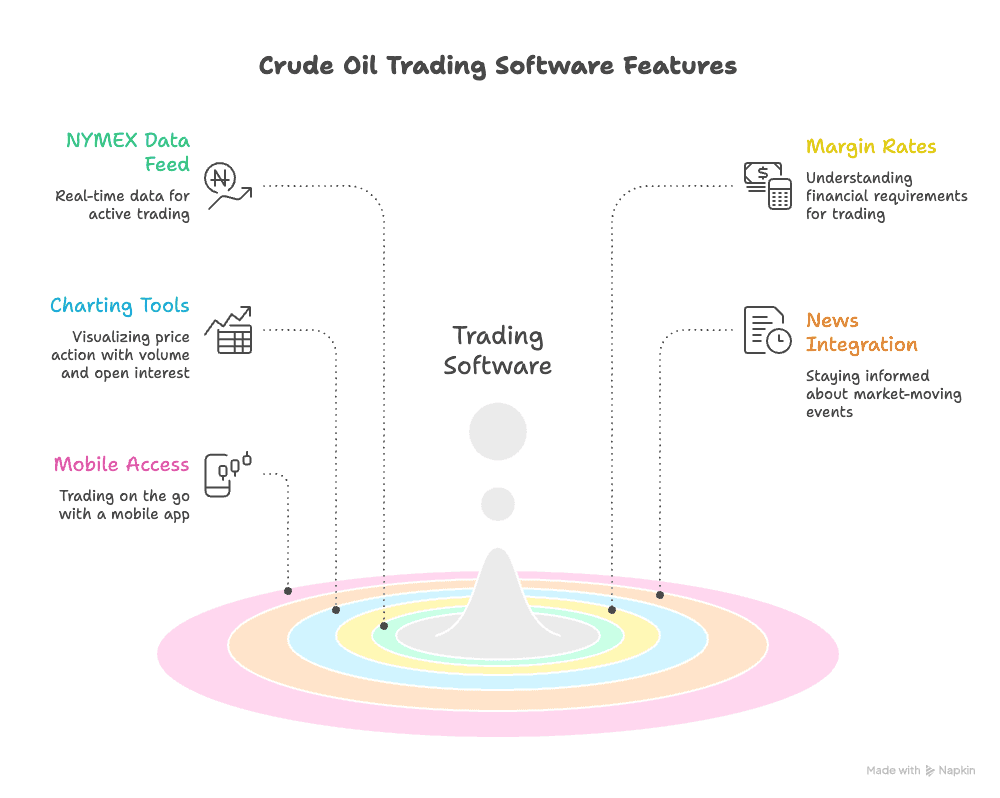
What to Look For in Crude Oil Trading Software#
Not every futures platform handles energy contracts equally well. Here are the specific platform requirements for trading CL or MCL:
- NYMEX data feed — Real-time NYMEX data is required for trading crude oil futures actively. Check whether your platform includes NYMEX data in its standard subscription or charges separately. This is a different data feed from CME equity data (ES, NQ), so confirm it's specifically available.
- Margin rates for CL and MCL — CL day-trading margin typically runs $3,000–$6,000 per contract depending on your broker and current volatility conditions. MCL day-trading margin is typically $300–$600. Confirm current rates with your broker, as margin requirements increase during volatile periods.
- Charting with volume and open interest — Oil traders closely watch volume and open interest to assess whether price moves are driven by new participation or position liquidation. A platform with volume histogram overlays and open interest data provides better context for CL price action.
- News integration and EIA calendar — Crude oil is heavily influenced by scheduled economic reports, especially the EIA (Energy Information Administration) weekly petroleum inventory report, released every Wednesday at 10:30am ET. Many traders avoid holding positions going into this report due to volatility spikes. A platform with an integrated economic calendar or news feed makes it easier to track these events.
- Mobile access — Oil reacts to geopolitical news, OPEC announcements, and weather events during all hours. A reliable mobile app with order entry and account management lets you respond to overnight developments.
Key Events That Move Crude Oil#
Understanding which events create volatility in CL helps you manage risk more effectively:
- EIA Weekly Petroleum Inventory Report (every Wednesday, 10:30am ET) — The most important regular data release for crude oil. A larger-than-expected inventory build (supply increase) typically pressures oil prices lower; a larger-than-expected draw (supply decrease) tends to push prices higher. Volatility during this release can be sharp and fast.
- OPEC and OPEC+ meetings — Production quota decisions from OPEC members move oil prices significantly. Major decisions are announced irregularly but are well-telegraphed in advance.
- Geopolitical events — Disruptions to supply chains, conflicts in oil-producing regions, and sanctions on major exporters can move crude prices substantially in short periods.
- US Dollar strength — Crude oil is priced in US dollars globally. When the dollar strengthens, oil becomes more expensive for foreign buyers, which can suppress demand and weigh on prices. The inverse is also true.
This is why crude oil trading software needs reliable news integration — these events are scheduled and predictable, making pre-event risk management possible.
Common Mistakes When Trading Crude Oil Futures#
- Underestimating contract size — One CL contract represents $10 per tick. A 50-tick move — which can happen in seconds on the EIA report — equals $500 profit or loss. New traders often don't internalise this scale until they experience a large adverse move. Start with micro crude (MCL) to build familiarity with the contract's behaviour at 1/10th the risk.
- Holding through the EIA inventory report — Unless you have a specific directional thesis and appropriate risk management in place, holding a CL position through the Wednesday 10:30am inventory report is high-risk. Prices can spike $1–3 in seconds immediately after the release. Many experienced traders go flat before the number drops.
- Not using micro crude (MCL) to start — MCL exists precisely for traders learning the crude oil market. The tick value is $1 instead of $10, the margin is 1/10th of CL, and the exposure is proportionally smaller. There is no meaningful learning advantage to trading the full CL contract before you've proven a strategy in MCL.
Key Takeaways#
- Crude oil futures (CL) trade on NYMEX in 1,000-barrel contracts; micro crude (MCL) is 100 barrels.
- CL is highly liquid and volatile — tick value is $10; a small adverse move has significant dollar impact.
- Start with MCL to learn the crude oil market at 1/10th the risk before trading full-size CL.
- The EIA weekly inventory report (Wednesday 10:30am ET) is the most important scheduled volatility event for oil.
- NYMEX data is a separate feed from CME equity data — confirm it's included in your platform's data package.