Introduction#
Choosing the best trading platform in UAE is one of the most consequential decisions a retail trader makes. The platform you use every day shapes execution speed, chart analysis depth, cost transparency, and the regulatory protections that sit behind your account. Get it wrong and you may face hidden fees, poor order fills, or inadequate safeguards.
The UAE has grown into one of the most active retail trading markets in the Middle East. Dubai's financial infrastructure — anchored by the Dubai International Financial Centre (DIFC) and its regulator the DFSA — provides a credible local framework. Alongside it, the Securities and Commodities Authority (SCA) oversees the broader federal market, and Abu Dhabi's ADGM free zone adds further depth. Many UAE-based traders also access brokers regulated internationally by the FCA (UK), ASIC (Australia), or CySEC (Cyprus).
This guide covers platform types, features to evaluate, cost structures, and regulatory considerations specific to the UAE. It does not rank specific brokers — the right choice depends entirely on your individual circumstances and trading goals.

What Is a Trading Platform?#
A trading platform is the software interface — desktop application, browser-based tool, or mobile app — that connects a trader to financial markets. It is where you execute orders, monitor open positions, analyse price charts, and manage risk controls.
The platform is distinct from the broker. Many brokers offer the same underlying platform (such as MetaTrader 5) but differ significantly in the trading conditions layered on top: spreads, commissions, execution speed, and available instruments. Evaluating a broker and evaluating its platform are separate steps.
Types of Trading Platforms Available in the UAE#
UAE-based traders typically encounter four categories of platform. Understanding the differences helps you narrow your shortlist based on trading style and goals.
MetaTrader 4 (MT4)
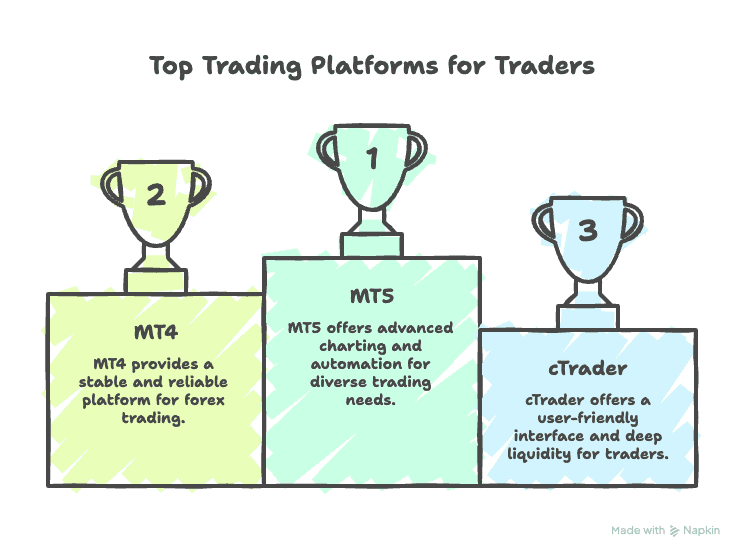
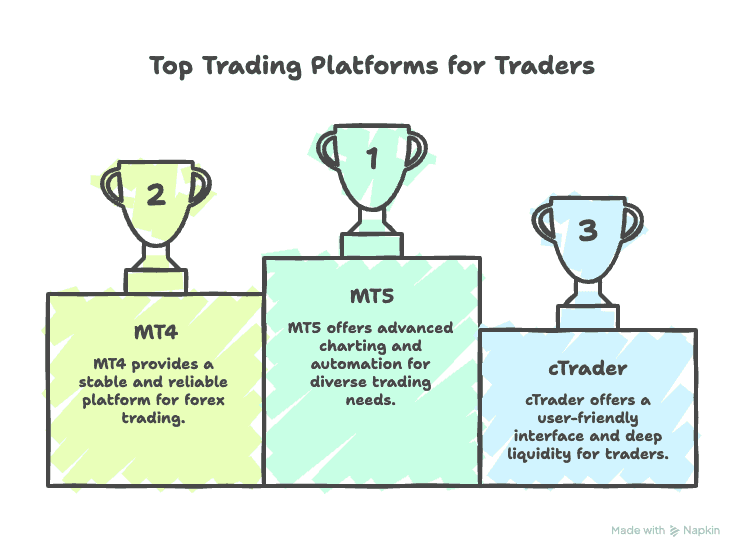
MT4 remains the most widely deployed retail trading platform globally. Launched in 2005, it is mature, stable, and extensively documented. Its strengths include a large library of built-in and custom technical indicators, robust support for Expert Advisors (EAs) — automated trading scripts written in MQL4 — and an active community of developers and educators. MT4 suits forex traders who value a familiar, well-supported environment. Its age, however, means it lacks some features found in newer platforms, particularly around asset class breadth and strategy testing depth.
MetaTrader 5 (MT5)
MT5 is the successor to MT4 and the current standard for most new broker deployments. Key improvements include expanded asset class support (forex, CFDs, stocks, and futures on one platform), an upgraded multi-currency strategy tester, additional order types such as Buy Stop Limit and Sell Stop Limit, and a depth-of-market panel for viewing order book liquidity. MQL5, its programming language, is more powerful than MQL4 for complex algorithmic strategies. Most brokers launching new products now use MT5 as their default. Note that MQL4 Expert Advisors are not directly compatible with MT5 without adaptation.
cTrader
cTrader is a professional-grade platform developed by Spotware Systems, offered by a smaller but growing number of ECN and STP brokers. Its distinguishing features include a clean, intuitive interface built for fast order entry, Level II pricing (depth of market) as a standard feature, and cAlgo — an algorithmic trading environment using C#, which is more accessible to developers with mainstream programming backgrounds. cTrader is particularly popular among traders who prefer transparency in pricing and a more modern interface than MT4/MT5.
Proprietary Platforms
Many brokers develop their own web or mobile platforms. Quality varies considerably. Some proprietary platforms are genuinely well-built, offering intuitive design, robust charting, and reliable order management. Others sacrifice analytical depth for simplicity in ways that limit more active traders. A key consideration: proprietary platforms are not portable. If you move to a different broker, you lose access to any customisation, saved layouts, or history built within them. MT4, MT5, and cTrader allow you to carry settings and scripts across any broker that supports those platforms.
Key Features UAE Traders Should Evaluate#
When assessing any trading platform for UAE-based use, focus on these criteria:
Charting and Technical Analysis — Does the platform support the indicators, timeframes, and drawing tools your strategy requires? MT4 and MT5 support hundreds of built-in and custom indicators. cTrader's charting is generally considered faster and more responsive.
Order Types — Market orders, limit orders, stop-loss, take-profit, and trailing stops are baseline requirements. Active traders should also look for OCO (One Cancels Other) orders and conditional triggers.
Execution Technology — Understand whether the broker operates a dealing desk, STP (Straight Through Processing), or ECN (Electronic Communications Network) model. ECN models generally offer tighter spreads and faster fills but charge a per-lot commission.
Instrument Coverage — Forex pairs, gold and silver (particularly relevant given the UAE's strong commodity culture), energy products such as crude oil and natural gas, global indices, individual shares, and cryptocurrency CFDs. Not all brokers make every instrument available on every platform.
Automation Support — If you plan to use automated strategies, confirm the platform supports Expert Advisors or bots and that the broker permits algorithmic trading without restrictions or throttling.
Reporting and Account Management — Trade history exports, daily account statements, and performance analytics matter for self-assessment. The UAE currently levies no personal income tax on trading profits, but traders who are residents from other jurisdictions may need detailed records for their home country reporting.
Regulatory Considerations for UAE Traders#
Regulation is the most important structural factor for any trader — not an administrative formality. The UAE's regulatory landscape involves several bodies:
DFSA — Dubai Financial Services Authority
The DFSA regulates financial services firms operating within the DIFC (Dubai International Financial Centre) free zone. DFSA-licensed brokers must maintain minimum capital adequacy levels, hold client funds in segregated accounts separate from the firm's own capital, and submit to regular audits. The DFSA's public register at dfsa.ae allows anyone to verify a firm's current licence status.
SCA — Securities and Commodities Authority
The SCA is the UAE's federal financial regulator for securities, commodities, and derivatives across the mainland and emirates outside the DIFC and ADGM. SCA-licensed entities are permitted to solicit UAE retail clients directly and must comply with specific conduct of business requirements.
FSRA — Financial Services Regulatory Authority (ADGM)
The FSRA operates within the Abu Dhabi Global Market (ADGM) free zone on Al Maryah Island. It maintains standards broadly comparable to the DFSA and has its own public licence register. ADGM has grown as a financial hub alongside DIFC, and several brokers hold FSRA authorisation.
International Regulators
Many brokers accessed by UAE residents hold licences from the FCA (UK), ASIC (Australia), CySEC (Cyprus), or other internationally recognised regulators. These carry meaningful client protections. The practical question for UAE traders is which regulatory entity actually holds your account. A broker may be FCA-regulated at its UK parent company level but service UAE clients through an offshore subsidiary with materially different protections.
Key insight: Always confirm in writing which specific regulated entity your account is opened under, and verify that entity's status on the relevant regulator's public register. The entity that holds your funds determines the protections you receive — not the brand name on the website.
Platform Costs: Spreads, Commissions, and Swap Rates#
Every trade carries a cost, whether visible or embedded in the price. Understanding the cost structure attached to a platform and broker combination is essential for realistic return expectations.
Spread-based pricing — The broker earns from the bid/ask spread. Commonly marketed as "zero commission," the spread itself is the cost. Spreads typically widen during high-volatility periods or illiquid hours, which can significantly affect short-term trading strategies.
Commission-based pricing — Raw or near-raw spreads plus a fixed commission per lot traded. More transparent and typically lower total cost for active traders who generate significant volume.
Swap rates (overnight financing) — Any position held open past the daily rollover incurs a swap charge or credit, reflecting the interest rate differential between the two currencies or the financing cost for CFDs. Positions held for multiple days accumulate these costs.
Swap-free (Islamic) accounts — For UAE traders observing Islamic finance principles, many brokers offer swap-free accounts that replace overnight interest with an alternative fee arrangement. The structure of these accounts varies between brokers — some use a flat administration fee, others apply widened spreads after a threshold period. Review the documentation carefully before selecting a swap-free account.
Deposit and withdrawal fees — Bank transfers, credit and debit cards, and e-wallets (Skrill, Neteller) each carry different costs and processing times. Some brokers serving UAE clients support local bank transfer options with faster processing.
Mobile vs Desktop Trading in the UAE#
The UAE has one of the highest smartphone penetration rates globally, and mobile trading is widely used. MT4, MT5, and cTrader all have dedicated iOS and Android apps. Most proprietary platforms also offer mobile versions.
Mobile platforms provide full order management, real-time quotes, and alert notifications. However, chart analysis depth and complex multi-order management are typically more practical on desktop or web-based interfaces. Drawing tools, multi-timeframe setups, and watching multiple instruments simultaneously are better served by larger screens.
Many UAE traders use a hybrid approach: desktop or web platform for analysis and strategy, mobile for trade execution and position monitoring when away from a workstation. When evaluating a mobile app, assess stability (review App Store and Google Play ratings for crash reports), charting quality, biometric login support, and whether push notifications for margin calls and price alerts are reliable.
How to Choose Based on Your Trading Style#
There is no single best platform — the right choice aligns with your experience level, strategy type, and priorities:
Beginners — Start with MT4 or a well-designed proprietary platform, ideally on a demo account. Focus on understanding order management, position sizing, and stop-loss placement before evaluating advanced features. The goal is competence, not sophistication.
Intermediate traders — MT5 offers meaningful depth beyond MT4 without adding excessive complexity. Its improved strategy tester and broader asset class access make it a natural progression. cTrader is worth evaluating for those who prefer a cleaner interface and transparent ECN pricing.
Active and algorithmic traders — MT5 (MQL5) and cTrader (cAlgo) are the strongest options for automation. Both support sophisticated strategies. If you already run MT4 EAs, verify whether your scripts can be adapted to MQL5 or whether MT4 access is still available at your preferred broker.
Traders with Islamic finance requirements — Prioritise brokers offering genuinely swap-free accounts with clearly documented alternative fee structures. Not all Islamic accounts are structured equivalently; some replace swaps with equivalent charges under different labels.
Regardless of experience level, always test a platform using a demo account before depositing real capital. Demo environments replicate live platform conditions and allow you to validate execution quality, interface usability, and order management before committing funds.
Quick Summary#
- The best trading platform in UAE depends on your trading style, experience level, and regulatory priorities — not a single universal answer.
- MT4 is the most widely available; MT5 is the modern standard with broader asset coverage; cTrader suits ECN-model brokers; proprietary platforms vary significantly in quality.
- Regulatory status is critical — verify which specific entity holds your account and under which jurisdiction. Use public regulator registers to confirm.
- Total cost includes spreads, commissions, and overnight swap rates. Compare the full picture rather than headline spreads alone.
- Swap-free Islamic accounts are available at many brokers serving UAE clients — review the terms carefully.
- Always test a platform on demo before going live.
Related Concepts#
- Best Forex Brokers in UAE — How to evaluate forex brokers available to UAE traders
- Best Trading App in UAE — What to look for when choosing a mobile trading platform
- How to Open a Trading Account in UAE — Step-by-step guide to getting started