Finding the best forex brokers in UAE requires more than comparing headline spreads. The UAE presents a unique regulatory landscape, a culturally significant demand for Islamic swap-free accounts, and a broad mix of locally authorised and internationally regulated brokers all competing for retail clients.
Forex trading is legal and widely practised in the UAE. The country's financial infrastructure — the DIFC in Dubai, the ADGM in Abu Dhabi, and the broader federal regulatory framework under the SCA — means traders have access to meaningfully regulated options alongside the wider international broker market.
This guide explains the key criteria for evaluating forex brokers in the UAE, what the regulatory labels mean in practice, and what to examine before opening an account. It does not rank or endorse specific brokers.
Is Forex Trading Legal in the UAE?#
Yes, forex trading is legal in the UAE for residents and expatriates. The UAE has established regulatory bodies specifically to govern financial services including forex and CFD trading. Both locally licensed brokers and internationally regulated brokers with UAE client operations are permitted to offer services to UAE residents.
There are no restrictions on UAE residents opening accounts with regulated international brokers, provided those brokers hold licences from recognised regulatory authorities. Traders should, however, understand the difference between what is legally permitted and what level of client protection applies under different regulatory frameworks.
Who Regulates Forex Brokers in the UAE?#
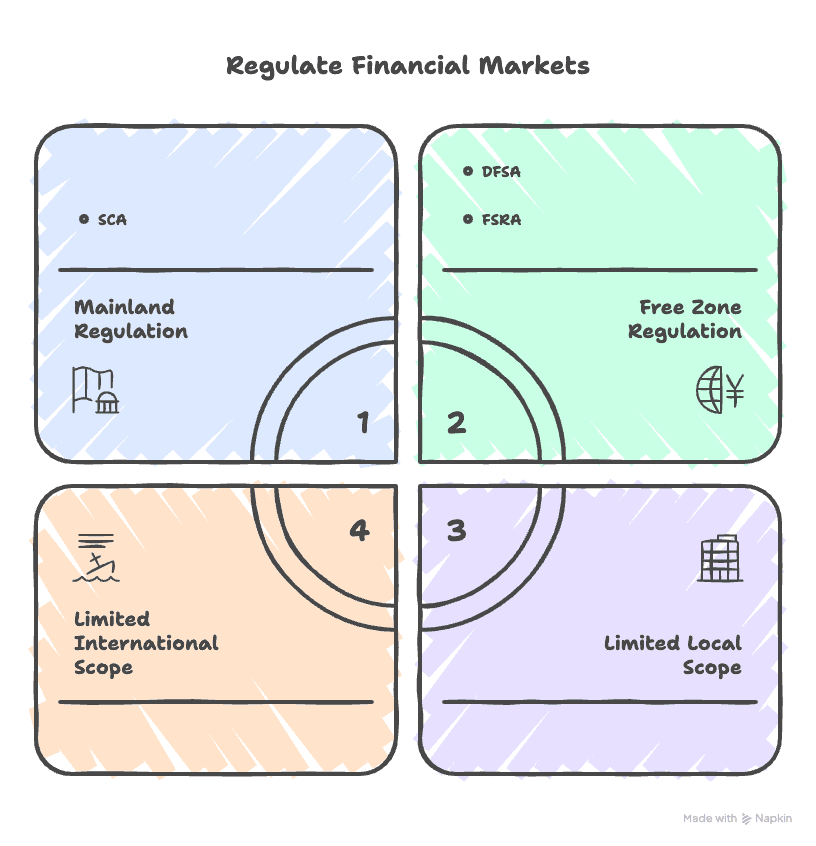
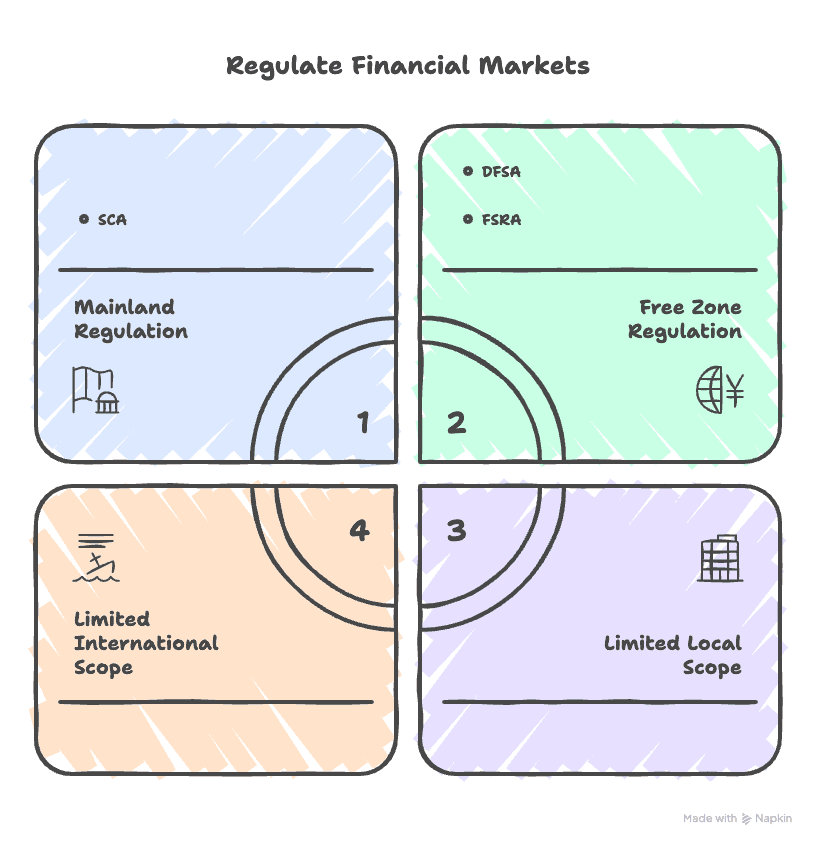
The UAE has a layered regulatory structure. Three bodies are most relevant to retail forex traders:
DFSA — Dubai Financial Services Authority
The DFSA is the independent financial regulator of the Dubai International Financial Centre (DIFC), a financial free zone that operates under its own legal and regulatory framework separate from the wider UAE. DFSA authorisation requires brokers to meet capital adequacy requirements, segregate client funds, and adhere to strict conduct of business rules. The DFSA public register at dfsa.ae allows traders to verify any firm's current licence status within minutes.
SCA — Securities and Commodities Authority
The SCA is the federal financial regulator with jurisdiction across the UAE's mainland and emirates outside the DIFC and ADGM free zones. The SCA licenses firms to offer securities, derivatives, and commodity trading to UAE residents. SCA-regulated brokers are authorised to actively market and solicit retail clients across the country.
FSRA — Financial Services Regulatory Authority (ADGM)
The FSRA operates within Abu Dhabi Global Market (ADGM), a financial free zone on Al Maryah Island. Its regulatory standards are broadly comparable to those of the DFSA. The ADGM has grown steadily as an international financial centre and a number of global brokers have sought FSRA authorisation to serve the Abu Dhabi market.
Understanding which regulator covers your broker is not a technicality — it determines the specific conduct standards, capital requirements, and client protections that apply to your account.
Key Criteria for Evaluating a UAE Forex Broker#
When assessing any forex broker for UAE-based use, evaluate the following systematically:
Regulatory status — Which entity holds your account and under which regulator? Verify this on the relevant public register, not just on the broker's own website.
Execution quality — Does the broker operate a dealing desk, STP, or ECN model? ECN execution generally offers tighter spreads and faster fills but charges per-lot commissions.
Instrument coverage — Major, minor, and exotic forex pairs, metals (gold and silver are particularly relevant to UAE traders), energies, indices, and any other markets you intend to trade.
Platform availability — MT4, MT5, cTrader, or a proprietary platform. Your choice of broker should align with the platform you want to use, or vice versa. See our guide to trading platforms in the UAE for a full breakdown.
Customer support — Availability, language support (Arabic is relevant for many UAE traders), and response times across channels. Support quality is difficult to assess without direct testing — use the demo account process as a gauge.
Withdrawal reliability — Timely, low-cost withdrawals are a basic requirement. Research reviews and community forums for accounts of withdrawal delays or complications.
Account Types Available to UAE Traders#
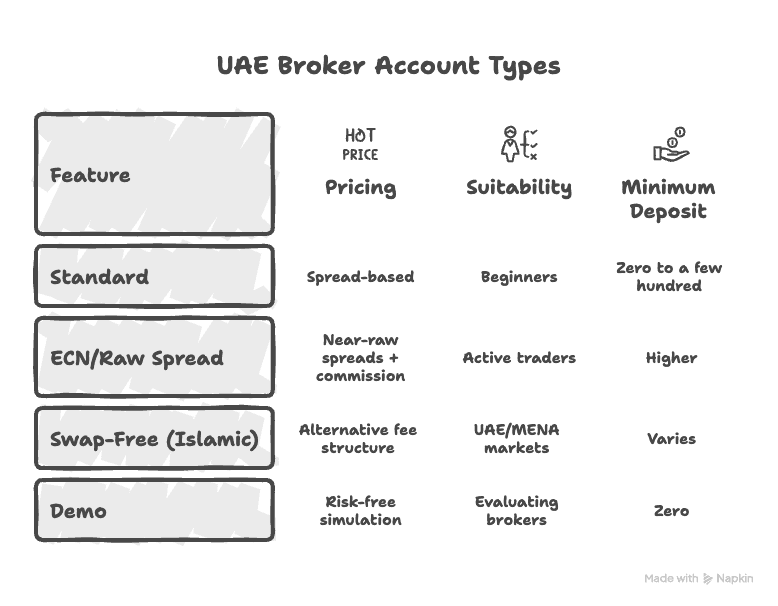
Most forex brokers offer multiple account tiers to suit different experience levels and capital sizes:
Standard accounts — Spread-based pricing, no per-trade commission. Suitable for beginners. Minimum deposits typically range from zero to a few hundred US dollars depending on the broker.
ECN or Raw Spread accounts — Near-raw spreads plus a commission per lot. Lower total cost for active traders who generate significant volume. Often require a higher minimum deposit.
Swap-free (Islamic) accounts — Available at many brokers serving UAE and broader MENA markets. These accounts remove overnight interest (swap) charges in accordance with Islamic finance principles and replace them with an alternative fee structure. The nature of that alternative structure varies — some brokers apply a flat administration fee, others use an extended spread after a grace period.
Demo accounts — A risk-free simulation environment replicating live conditions. Essential for evaluating a broker's platform, execution, and overall suitability before committing real capital.
Key insight: Swap-free account terms vary considerably between brokers. Before selecting an Islamic account, review the documentation carefully to understand exactly what charges replace the standard swap — and on which instruments and holding periods those charges apply.
Understanding Spreads, Commissions, and Overnight Fees#
The cost of trading is rarely a single number. UAE traders should account for three layers:
Spread — The difference between the buy (ask) and sell (bid) price. On spread-based accounts, this is the primary cost. Spreads widen during low-liquidity periods and around major news events, which can significantly impact short-term strategies.
Commission — Charged on ECN or raw spread accounts. Expressed as a fixed dollar amount per standard lot (100,000 units) traded. Comparing commission-inclusive total cost rather than spread in isolation gives a more accurate picture.
Overnight (swap) rate — Applied to positions held past the daily rollover, typically at 5pm New York time. Rates vary by currency pair and change with central bank interest rate decisions. Traders holding positions for multiple days accumulate these costs.
When comparing brokers, calculate the effective cost per round trip (opening and closing a trade) under realistic trading conditions — not the lowest possible spread quoted during peak hours.
Platforms Offered by UAE-Accessible Brokers#
The majority of forex brokers accessible to UAE residents offer MetaTrader 4, MetaTrader 5, or both. A smaller number offer cTrader, which is preferred by ECN-oriented brokers. Some brokers also offer proprietary web and mobile platforms alongside the MetaTrader suite.
Platform availability matters because it determines what analytical tools, automation capabilities, and order types you have access to. If you already use a specific platform or have invested time in developing tools for it, choosing a broker that supports that platform is a practical priority.
For a detailed comparison of MT4, MT5, cTrader, and proprietary platforms, see: Best Trading Platform in UAE.
Swap-Free (Islamic) Account Considerations#
The UAE's Muslim population, along with a significant portion of the wider Muslim expatriate community, may seek trading accounts that comply with Islamic finance principles — specifically the prohibition of riba (interest). Swap-free accounts address this by removing overnight interest charges.
The key questions to ask a broker about its Islamic account offering:
- What specific charges or fees replace the swap? Is there a flat fee, a widened spread after a grace period, or another arrangement?
- On which instruments is the Islamic account available? Some brokers restrict swap-free status to major forex pairs and exclude metals, energies, or indices.
- Is the arrangement formally documented and transparent, or is it presented informally without clear terms?
Not all swap-free accounts are structured equivalently, and traders should review the terms alongside any relevant guidance from their own financial or religious advisor before selecting an account type.
How to Open a Forex Account in the UAE#
The standard process for opening a forex account in the UAE involves several consistent steps:
- Select a broker based on the criteria above — regulation, costs, platform, and account type.
- Register online by providing your name, email, and country of residence. Most brokers offer instant online registration.
- Verify your identity (KYC) — submit a government-issued photo ID (UAE national ID, passport, or Emirates ID for expatriates) and proof of address (a recent utility bill, bank statement, or official document showing your UAE address).
- Choose your account type — standard, ECN, or Islamic. If starting out, a demo account first is advisable.
- Fund your account — via bank transfer, credit/debit card, or e-wallet. Processing times and fees vary by method and broker.
- Download and configure your platform — install MT4, MT5, cTrader, or the proprietary app, log in with your account credentials, and configure your workspace.
Verification typically takes between a few hours and two business days depending on the broker and the clarity of the submitted documents.
For a detailed step-by-step walkthrough, see: How to Open a Trading Account in UAE.
Quick Summary#
- Forex trading is legal in the UAE and supported by a multi-layered regulatory framework: DFSA (DIFC), SCA (mainland UAE), and FSRA (ADGM).
- Always verify which specific regulated entity holds your account using the relevant regulator's public register.
- Evaluate brokers on regulation, execution quality, instrument coverage, platform availability, and withdrawal reliability — not on spreads alone.
- Account types include standard spread-based, ECN/raw spread, and swap-free Islamic accounts. Each suits different trading styles and capital levels.
- Total trading cost = spreads + commissions + overnight swap rates. Compare the full picture.
- Swap-free account structures vary significantly between brokers — review the terms before committing.
- Start with a demo account to assess a broker's platform and execution quality before depositing live funds.
Related Concepts#
- Best Trading Platform in UAE — Platform types, features, and how to choose the right one
- Regulated Forex Brokers in UAE — Understanding the UAE regulatory landscape in depth
- How to Open a Trading Account in UAE — Step-by-step account opening guide